To be pedantic, the Roman Empire did not fall in 472. It lived on in the eastern Mediterranean for another one thousand years. The Eastern Romans even took back a fair amount of western Roman holdings for a bit. The people who actually killed the Roman Empire were the Franks, permanently weakening it during the Latin occupation.
The Catholic church is an institution of the Roman Empire, and it's still around. That puts things in perspective, I find, and makes me wonder if 100 thousand years from now, historians will just lump the Romans and us into the same bucket.
I've always thought of the USA as the east Roman Empire of the British Empire. The seat of the throne moved to the white house, but the USA is still culturally close to the UK. Except for the religion, which seems to come from The Netherlands and Germany.
that's a stretch. it's hard to argue it's a continuity when there were two (2) direct wars where the US aggressively rejected British domination -- and then set about creating a entirely separate form of government.
in concert there was the Great Revival and a whole new emergence of new world evangelicalism, a far cry from the Church of England.
This is a really interesting idea. I'd never put this together myself, but its really compelling. It really shows the value of the phrase "history doesn't repeat, but it does rhyme".
> Except for the religion, which seems to come from The Netherlands and Germany.
Which religion brings those thoughts to mind? As an American I often find myself combining a handful of the American denominations into one, but I’m interested to hear what an outsider sees projected.
Basically, the whole protestant faction. A sibling comment mentions Lutheran (German) and Mennonites (Dutch). There is of course catholicism from the Irish, but the Anglicans are suspiciously small.
Isn't that just because a large portion of the early English colonialists moved to the USA precisely because they weren't Anglicans?
See for example the Mayflower: they left England due to prosecution, moved to The Netherlands, then left for the USA because there was too much freedom for them and they wanted to impose stricter rules.
There's of course the obvious heritage in the sense that the Reformation started in Germany, but movements like the Mennonites have never really caught on there or in The Netherlands.
They only took off once they landed in the USA, so I wouldn't call that a change of seat.
Well, considering that Puritans actually managed to push through the prohibition on Christmas (and Easter) celebrations, it's no wonder they got so wildly unpopular that they had to emigrate.
> The seat of the throne moved to the white house, but the USA is still culturally close to the UK
> Except for the religion, which seems to come from The Netherlands and Germany.
This underestimates how Germanic, Irish, Italian, and Hispanic America is.
For example - Hot dogs, Hamburgers, Budweiser, Chrysler, Rockefeller, Disney, the New York Times, Christmas Trees, Lutheran congregations, Mennonite congregations, etc are all German.
And having stayed in the UK for extended periods for work, it is significantly different culturally speaking than much of the US.
> Walt Disney was born on December 5, 1901, at 1249 Tripp Avenue in the Hermosa neighborhood of Chicago, Illinois, United States. He was the fourth son of Elias Disney, who was born in the Province of Canada to Anglo-Irish parents, and Flora (née Call), an American of German and English descent
You could also interpret this statement in a way that has nothing to do with exploitation. A lottery winner doesn’t exploit anyone, but they don’t “earn” their money either. I’ve always thought of the founder path to a billion as a bit like a lotto game where you can shift the odds through hard work and natural ability. I don’t think this process necessarily involves exploitation (although it certainly could). You’d have to believe in the labor theory of value for that. And I’m not convinced that even Marx would, were he alive today. It was supposed to have a scientific basis, after all, and that evaporated a long time ago.
I don’t understand this question at all. Types are there to prevent human programmers from making a certain class of mistakes. But is the same true for AI. Because if not, static types are just needless cruft.
Types always have to be checked. Either at compile time or at runtime. And if you're weakly typed you still check them to see if you use normal or backup behaviour.
If you're statically typed you can remove the actual check from the binary. They are therefore also a performance thing.
I’m inclined to believe that you are being too charitable to the interviewers. This is an early stage mental health startup. They totally could have been asking very personal questions. I believe this used to be standard when interviewing psychoanalysts. They could have stopped the author at any time too. That would be the most natural thing. I’m inclined to believe that it was a clown show and they conducted borderline abusive interviews. Shame on them. But also, beware early stage startups. It’s a real roll of the dice and the dice are weighted against you.
If Europe wants to pick up the slack, it needs to start pumping an order of magnitude more money into its universities than it currently does. US universities dominate because they are rich. As a holder of a PhD from a European university, I don’t see this ever happening. But I would love to be proved wrong.
My gripe is how iOS allows these companies to constantly bug us to use their stupid apps. I ended up installing the NYTimes app, not because I use it, but just to shut it up. I switched to duck duck go because I was sick of being bugged to install chrome. How many times do I need to say no?
I used to have a pro-cursor subscription, but it was way too expensive because I'd always hit my limit. I realized I could just use claude code + the free version of cursor for autocomplete and it worked even better. At this point, I'm not understanding the value that cursor is bringing. A souped up claude code? All I have to do is wait a few months and anything useful will be in claude code or codex or whatever.
So unfortunately this is it for me too. I liked Cursor as a tool, but when i switched to Claude I realized i was getting WAY better value for money. I spent $1800 the month before, i spent $200 the next.
I'm now switching between Claude and Codex for less than 1/4 of what I was spending in December.
Yeah, I tried using their Composer model (which I guess is Kimi) and it just feels sub-Sonnet to me. Whereas a Claude Max sub gets me more Opus than I can use in a month.
Which sucks because Cursor is clearly better than Anthropic at building UIs. CC desktop is buggy af.
Codex is nearly Opus level though. Anyone know if OpenAI permits Max subs to be used in Cursor?
I’d guess that there is less of a need for light at the beginning of the day since most people don’t farm. Personally I prefer more light at the end of the day.
I don't get that argument. The numeric time is just a measure for the state of the sun in the sky. When you choose your day to have ended is completely independent. There is already a high enough variance of people deciding when they go to sleep, that DST is hardly relevant. Some people have dinner at half past 5, some do at half past 8, the hour daylight saving time can't possibly make that difference.
It's not just a measure for the state of sun in the sky, it's also a measure for the state of society on the ground. It's an arbitrary number in a sense, but it also strongly influences my schedule.
And yes, we could have all the schools and everything else open later in the winter than the rest of the year, but it turns out it's easier to change the clocks.
But the school schedule does already shift and it shifts later, so in the opposite direction. The policy trend is going in the opposite of what you want to achieve with year-long DST, you could instead vote for the status quo and have the same effect.
Do BC schools have a different winter schedule? That's not how it is where I live, at least. It seems like it would be pretty annoying to have to reschedule activities around getting to/from school twice a year.
I can only comment on some parts in Germany, and no I don't know of different seasonal schedules. I meant that the general trend is for the school day to start later, so that the teenagers get more of their precious sleep. Year-long DST would get them to get up earlier again compared to the sun. This trend is the same for office hours and working shifts, they become later, since people just want to sleep longer. (Which is obviously bullocks.)
Exactly, here in Spain we have lunch between half past 2 and half past 3 on workdays, which can extend up to 5pm in the weekend and I usually finish dinner at half past ten.
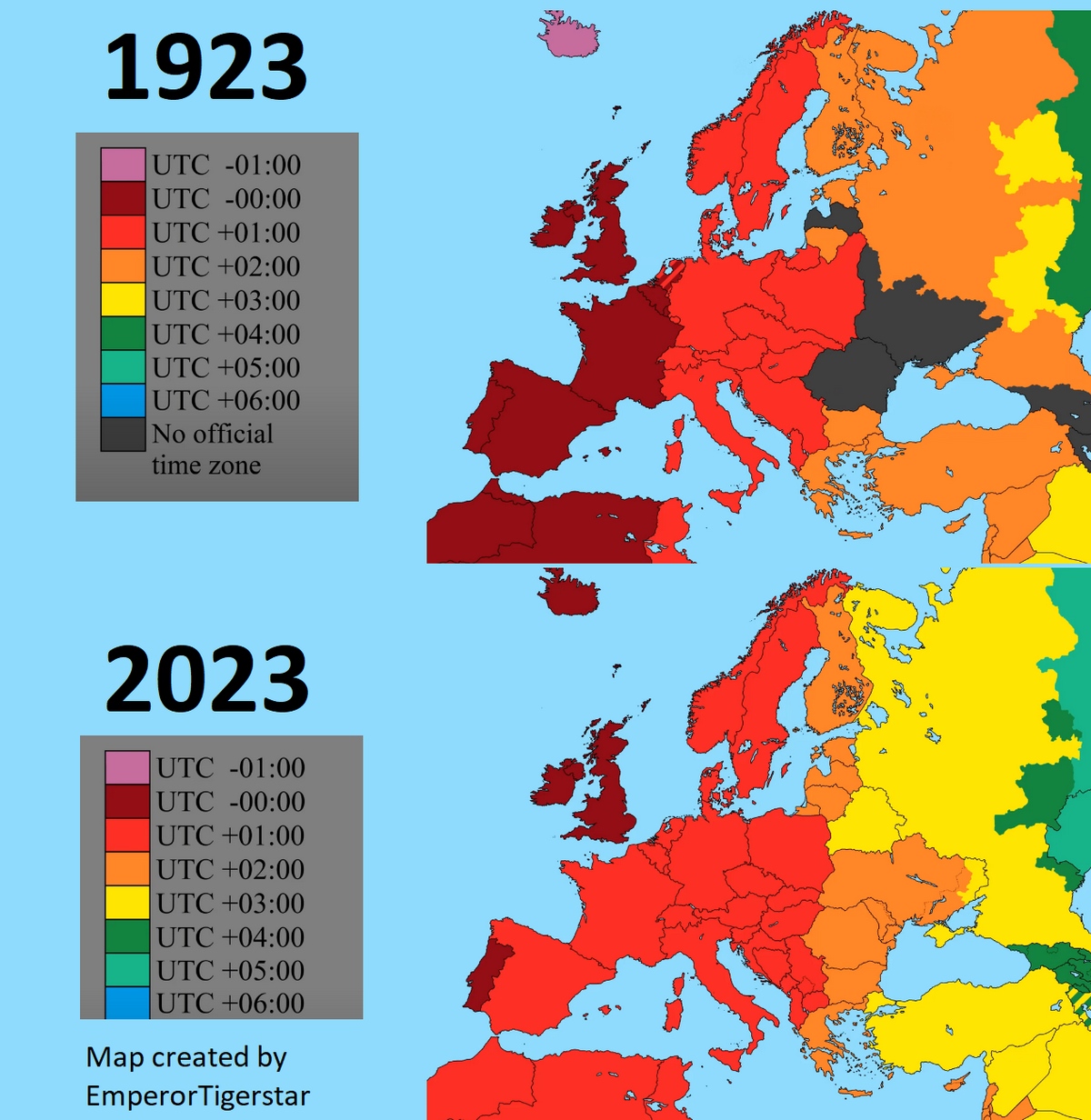
Why? because they decided to be on the same timezone as our eastern neighbors in Europe.
The eastern part of Polonia is on the same timezone and probably have probably the opposite with much much earlier lunch and dinner than we do.
The timezone centered across Görlitz made a lot of sense for the German empire, because it was nearly in half longitude wise and 15° away from Greenwich. It is still somewhat centered in Europe. If you wanted to divide it again, you would need to decide whether the border should be between Germany and France or France and Spain. If you place it between Germany and France, which side will the BeNeLux countries be on? France still has some parts that are nominally in +1 and we don't want to disturb the German-French "friendship", so maybe place it between Spain and France, where there is at least a mountain border? Would that be acceptable? Railways connections between Spain and France are also much less and concentrated than between Germany and France.
Farmers don't care about clocks, they do the work whenever needed. Roosters crow whenever they want. There's literally no point in talking about farmers in this debate.
I took a bunch of film classes in college and what they’re not mentioning is that sometimes the films bring assigned are crazy boring. I once had to watch an hour of footage shot from a camera in an outdoor elevator as it went up and down. One hour. The professor said it was the perfect summation of everything he’d been discussing over the term. I swear I’m not joking.
Perhaps as a film student you were meant to be looking at the composition, the shot structures, the color grading, the use of sound? The film may have been boring in its message or story but still a technical masterpiece?


reply