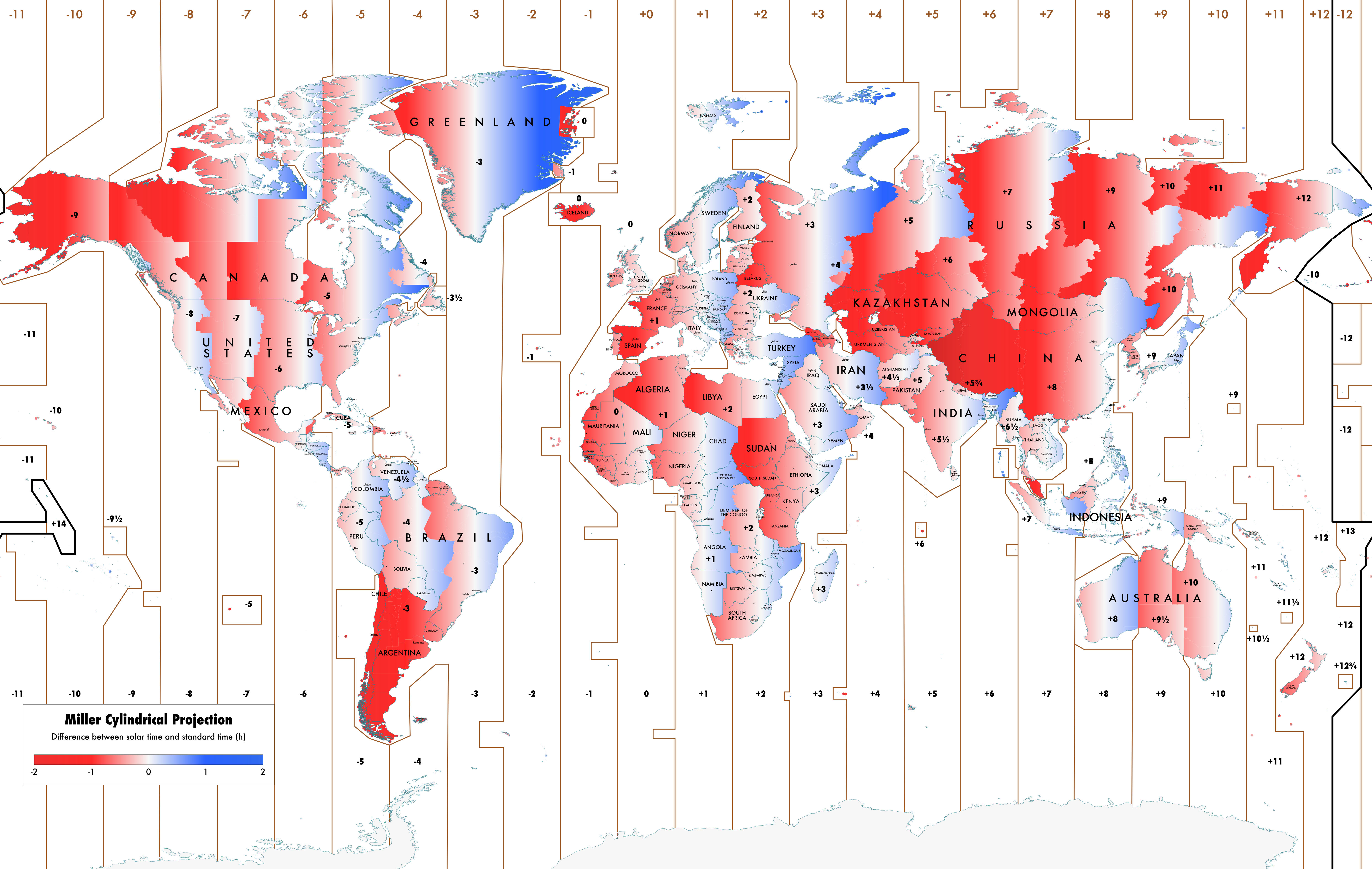
I think his error is in assuming that the zenith should correspond to the midway point of your workday. Which is entirely not true: Our society is organized around getting to work first thing in the morning, and having some sunlight left after work hours for social activities.
So Tokyo is set to a 9-5, but if they want to follow the same strategy of getting to work first thing in the morning, then they should be doing 7-3, or even a bit earlier due to DST non-observance.
Main point is that 9 AM means vastly different things, even counting for longitude. Standard time has become standard, in setting when people wake up, but it's far from the locally ideal situations.
As the picture shows, Spain and the parts of France are the extremes in the Europe, in the rest of Europe the Sun is closer to being at 12:00 (not counting DST) not too different to Tokyo.
Yes, the map you link shows is that some parts of the world have wider time zones than it would allow all the people living there to have the Sun very close to 12:00. But your "Tokyo sunrise" argument is still not a good one. All the areas (and cities) in the map that are "relatively white" have Sun at the highest point around 12:00 noon. Tokyo is "relatively white." New York and LA are also "relatively white." So I still don't know what is your perspective for Tokyo being strange. Can you please explain? The dramatic example would in fact be Spain or even Argentina.
I see even bigger error in his argument based on when "the Sun comes up" since it's dependent on the latitude even in the same time zone. He should ask somebody living close to the North pole.
When I lived in London the seasonal variation in sunrise was just one of those things you lived with.
Everyone gets wrenched by the start and end of BST, but generally if someone says "5pm" or "17:00" you get a seasonal sense of how much daylight that implies. I can't imagine the US - or anywhere else - being different, except possibly close to the poles.
Absolute sun position matters a lot less than the felt relationship between clock time and sun position. That sense changes slowly but reliably over the year.
The obvious benefit of time zones is that virtually everyone you interact with daily has the same subjective time sense. Everyone knows that midday is going to be bright, midnight is going to be dark, and the rest is going to vary with the season.
I've thought occasionally about a clock standard that has 0800 be sunrise every day, and run the rest of the clock until whatever time necessary to reach the next day's 0800 point... unworkable for blatant reasons but it would do away with the dissonance of waking up in darkness or post-twilight morning depending on seasons.
Yeah, I grew up in Oslo, Norway, and found his idea that the sun rising around 4am in summer was something unusual very strange. To me, sunrise occurring well before I wanted to wake up in summer was the norm.
But then we also have far longer periods of sunlight during the summer.
What's annoying me even now in London is that sunset still comes too early during the summer (during the winter, on the other hand, I definitively appreciate the longer days here vs. Norway)