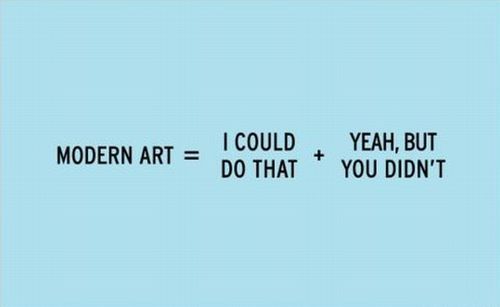
The artist deemed it art, therefore it is.
If you're wondering "Why is it art?" realize that you, wondering this, are the very justification of the art. It makes you wonder, it makes you react, therefore it is art.
(sorry I couldn't find it in another language). Basically a visitor of Venetian Biennale left a pack of biscuits in an empty space, took a couple of pictures and suddenly people started queuing at it, trying to find it in the catalogue and taking pictures too.
Simply calling something "art" doesn't make a difference in the actual content of the piece, so we might as well consider every entity as already having that label. Therefore everything/anything is already "art", and the question becomes whether a particular piece is "good" art.
  If someone mistaken it as trash and throw it away
  when cleaning up the gallery, then it is not art.
If trashmen are arguing whether or not a piece is art, then it is borderline art.
If they ignore it, then the art piece is art.
Otherwise, we have no standard at all, and the art world would only belong to elitist who can't draw a damn and status seeking idiot who up the price of a particular 'art piece'.
If someone mistaken it as trash and throw it away
when cleaning up the gallery, then it is not art.
Would a random person from the 1500s who did not grow up with Jackson Pollock as part of acquired culture know that they shouldn't just throw away a Pollock piece that was laying around?
And funnily enough, the reverse scenario played out at least once also. In 2009 in New Zealand a very controversial 1st prize of $15,000 was awarded to artist Dane Mitchell in the Waikato National Contemporary Art competition.
Dane did not even come over to NZ from his residence in Berlin, or send any artwork to the competition. He simply phoned in instructions to the janitor to wait until all the other exhibits had been prepared and their packing and scraps had been cleaned up, and then told the janitor to empty the contents of the rubbish bin and enter it as his sculpture :-)
The piece could, in theory, be restored to its previous form. But the question comes down to: is the art the result or the process that creates it? If it's the latter, then it can never be properly restored.
See, someone should "know" that it's a piece of art. Just by looking at it wouldn't be enough. Someone has to tell someone else that it's an art. And exactly that type of art is something I cannot digest.
Funny you should make that comparison. The first time I saw a large Pollock drip painting up close is probably one of the most profound art experiences I've had. Seeing it in full scale and being able to truly comprehend the the 3d texturing and layering and dynamics of the work was awe inspiring.
The truly amazing thing about the experience was really how completely by surprise it took me, I had no expectations or pre-conceived notions. I was just walking around the museum and all of a sudden there was this painting that I couldn't take my eyes off of. I probably spend half an hour just standing there studying it.
Conversely seeing the Mona Lisa in the Louvre left me completely unmoved. I mean don't get me wrong I totally get it's almost unprecedented cultural and historical significance and as an historic artifact I'm really glad I've seen it, and I completely appreciate the amazing skill and craftsmanship that's gone into it. But as Art and as a profound artistic experience it falls far short for me.
That's a terrible argument given that I consider Pollock paintings trash, not art. (Or in other words kiba's criteria is excellent and you just proved it.)
And I'm sure there are a lot of people who agree with me, but less who will say so.
Yes, you could perhaps call it Pareidolia. When I look at the aforelinked image http://www.terraingallery.org/Pollock-Number-One-1948.jpg , I see many things, or rather the hints of things. I have a hard time believing it is not intentional, or that the paint was thrown on canvas at random.
I don't see any characteristic shapes or figures in them; in fact, I'd say that would detract from it. If it's a sensory experience, a feeling transmitted in a very raw form.
It is also worth noting that, at least for me, seeing a tiny jpg of a Pollock can in no way compare to actually seeing the real thing. I was totally indifferent to his work right up until the point I stood face to face with an actual painting. The size and 3-dimensional textures and all the other little details that, to me, really make the works great, cannot be translated via an image.
That reminds me of a scene from that animation movie about Iran (Persepolis). There is a scene where someone can not get required heart surgery because the revolutionary party denies it - the person responsible for the decision is the former janitor of the person who needs the surgery.
In the same vein you want to leave it to trash men and cleaning ladies to decide what is valuable culture. I don't think it is a good idea (and I am trying hard to avoid Godwin's law here...).
That definition is limited to small physical objects. What about 4'33", is it art? What about Christo's works, like wrapping the Reichstag or the Umbrelllas[1] ?
That's not a very satisfying definition of art. I could put poop on a pedestal[^1] and it would do the same things, even more so. Yet I don't believe you should be calling that art.
"Art is the product or process of deliberately arranging items (often with symbolic significance) in a way that influences and affects one or more of the senses, emotions, and intellect" - Wikipedia.
Why not? Culinary art is art. If a crappy painting can be concidered badly made art, your pizza surely can be concidered badly made culinary art, at the very least.
I personally think that anything that was made with intention can be qualified as art; the only things that don't have any artistic merit are thos that are made completely by accident or hapenstance.
That just brings us back to jey's comment. If everything counts as art then the term 'art' has been stripped of meaning and now we need a new term for what used to be called 'art'. It's a waste of time.
There is a world of difference between claiming that something fits the common definition of art and claiming that we need to use an extremely expansive definition of art. I thought the argument here was about the former. If it's about the later then I'll not fight; I'll just note that we're not even discussing the piece and bow out.
By definition, your pizza is very low-grade art. It doesn't have any symbolic significance, it affects only 1 of "senses, emotions, intellect". Otherwise, it fits.
Why does it have to be "art OR not art"? Can't it be a spectrum? Like love? Or beauty? Or any other subjective concept you can think of?
It's not that somebody signed a urinal, it's that that urinal was signed. If you can't appreciate art, that doesn't invalidate the artistic statement being made.